
Before someone calls, books, or buys, they have questions. What do you offer? Are you the right fit? Why should they choose you?
Some of those questions are now going to ChatGPT. Your business could be getting sized up before you ever see a website visit or hear the phone ring.
That deserves your attention.
OpenAI’s new Business Hub lets eligible owners and representatives manage business information in ChatGPT and access discovery insights. It’s a useful place to start. The bigger opportunity is making sure customers can find clear, credible reasons to choose your business wherever they’re doing their research.
That’s where we come in. Our work brings together research, marketing strategy, content, website development, and analytics. We help businesses communicate what they offer, build stronger digital experiences, and measure their marketing. Those capabilities give us a practical starting point for deciding how new tools fit your business. [7-10]
Here’s what the new tools mean for your business—and where we recommend getting to work.
So, what do ChatGPT Business Profiles actually do?
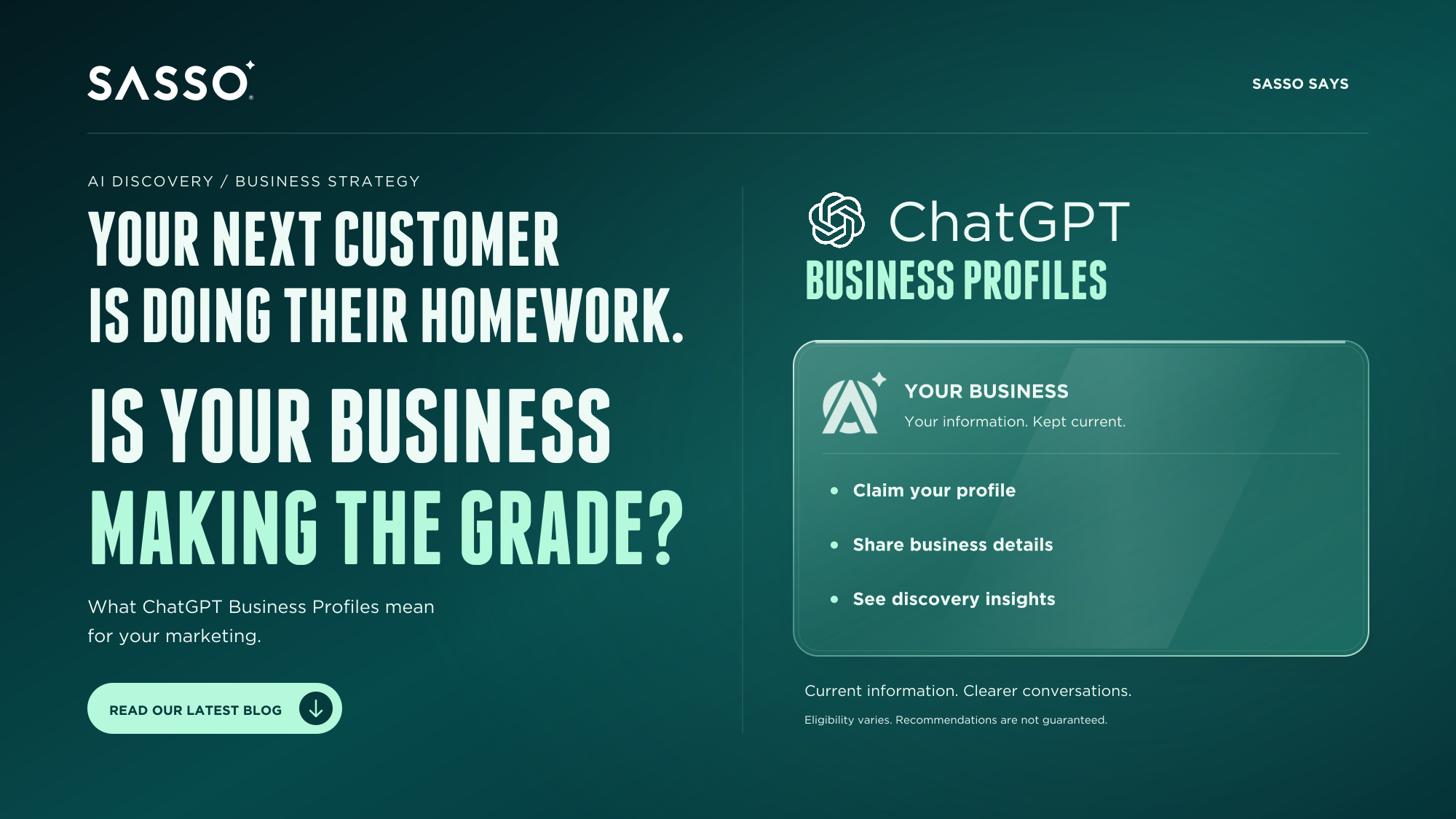
Think of the profile as the information customers can explore about your business inside ChatGPT. Business Hub is where an authorized owner or representative can claim and manage it. OpenAI introduced these tools in beta on November 10, 2026.
Once the required verification is approved, eligible businesses can contribute business details and product information. Retailers can connect a product feed to share prices and availability, including through Shopify. That gives you a direct way to supply information about what you sell and how your business operates. [1, 2]
Business Hub also offers aggregate discovery insights, including mentions, website clicks, and topics associated with your business. These can help you decide what to investigate next. They don’t reveal customers’ private conversations. [1]
Some businesses can go further with a Business Agent. Customers choose to open a separate, clearly labeled conversation where the agent answers questions using information the business supplies. At launch, agents are available to eligible U.S. e-commerce and online service businesses. [1, 2]
An agent might explain how two products differ or clarify a return policy. The current experience directs customers to your website to complete a purchase or booking. [3]
Here’s the distinction that matters: claiming your profile doesn’t guarantee more recommendations, better placement, or sales. ChatGPT can still draw on other sources. You’re contributing information to the experience; you aren’t writing every answer a customer receives. [2, 3]
Your business needs to answer the questions that win the job.
“Experienced team. Quality service. Customer-focused.”
Those words could describe almost anybody. They leave the customer doing the work of figuring out whether you can actually help.
Someone comparing contractors may need to know whether you handle commercial projects, serve their area, or have relevant work to show. A shopper comparing products may need dimensions, compatibility details, or a straight answer about returns.
Our view: those details belong in your marketing. If the answers are buried in a sales deck or live only in someone’s head, put them where customers can find them.
That starts with knowing your audience, understanding what makes your business a good fit, and backing up your claims. AI discovery gives us another reason to get that work right.
Make the visit count once customers reach your website.
Google’s guidance for its AI search features points businesses back to familiar priorities: useful content, pages that can be crawled and indexed, and accurate business information. There’s no special AI schema required to appear in those features. [4]
So keep investing in the information and experience you own. Give important services their own clear explanations. Make your product details useful. Show relevant work and credentials. Make contacting you, requesting an estimate, or buying something straightforward.
If a customer arrives ready to take the next step, your website needs to make that step easy.
What should you do first?
Start with the questions customers raise in sales calls and support requests. Which answers help customers decide whether to move forward? Review how well your website and business listings answer them.
Then check Business Hub eligibility. Access varies by business type and location. Local stores and restaurants can currently claim an existing U.S. listing. Follow the verification options offered for your business; identity verification through Persona must be approved before you can publish information changes or access insights. [3]
Business Hub and organic Business Agents are currently free, according to reporting from OpenAI’s launch briefing. Sponsored promotion is a separate paid option. Setup, content development, and ongoing management still take time and resources. [5]
Assign an owner to review business details when your services, products, or policies change. If an agent makes sense for your business and you’re eligible, test it against the questions customers actually ask before publishing it. [3, 6]
And decide what you want to learn. A mention can be useful to track, but a qualified inquiry or a purchase tells you something different. Review the available discovery signals alongside website activity and business results. Early results need context; one answer or one good week won’t tell the whole story.
Let’s put this into your marketing strategy.
A new platform gives you another decision to make. Our job is to help you make that decision with a clear understanding of your audience, your goals, and the work involved.
Through our research and strategy services, we examine market conditions and competitors, define goals and KPIs, and develop marketing plans. That’s the foundation for deciding where your business should focus its attention. [7]
Our digital marketing and content services include content strategy, content marketing, and SEO. We can help turn your expertise and business information into useful content that answers the questions customers bring to their research. [8]
Our website design and development services include website strategy, e-commerce development, landing page optimization, and UX/UI design. When someone reaches your website, the experience should make it straightforward to understand your offering and take the next step. [9]
And our analytics and reporting services connect measurement with interpretation and recommendations. We help define what success looks like and use available data to inform where the work goes next. [10]
Our recommendation is to put ChatGPT’s new business tools into that larger plan. Review your eligibility. Get your information in order. Keep your website useful. Give each new investment a purpose and a way to evaluate it.
Your customers have questions. Let’s make sure your marketing gives them something worth choosing.
Talk with us about your marketing strategy.
Sources
[1] OpenAI announcement, November 10, 2026
[2] OpenAI business overview
[3] OpenAI setup guide
[4] Google AI search guidance
[5] Digiday launch-briefing reporting, November 10, 2026
[6] OpenAI Business Agents Policy
[7] SASSO Research + Strategy
[8] SASSO Digital Marketing + Content
[9] SASSO Website Design + Development
[10] SASSO Analytics + Reporting


